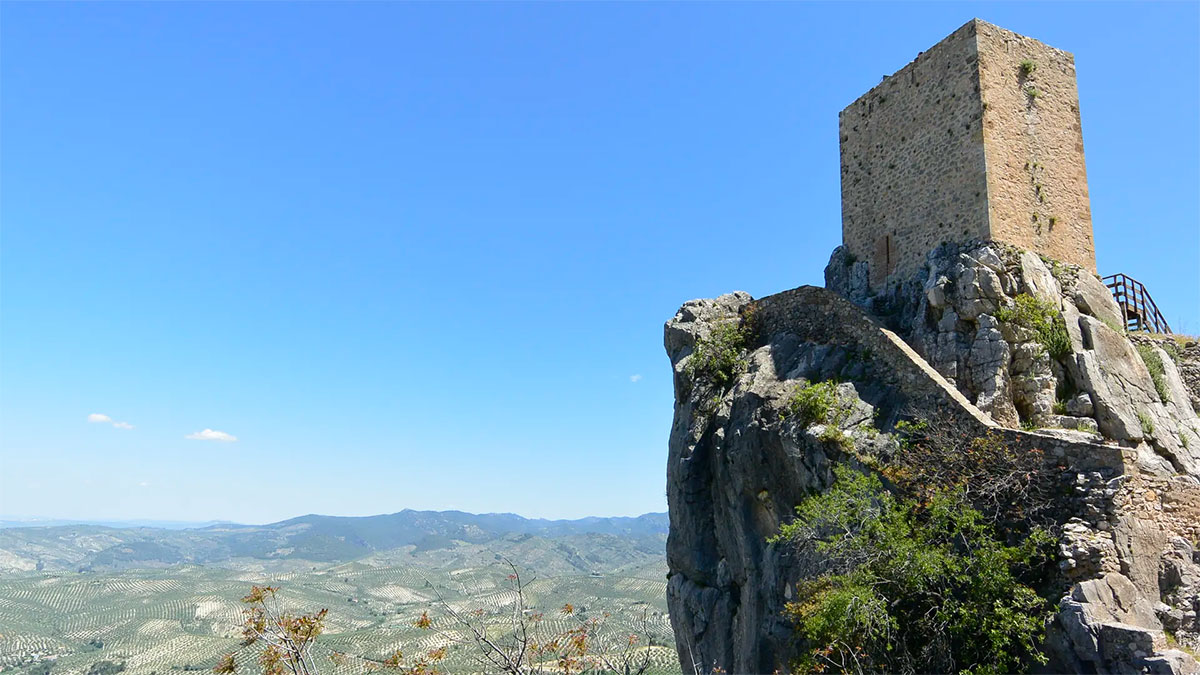

La Iruela Castle
- Interpretive Panel 2 -
LA IRUELA CASTLE
Origins and Islamic rule
The first settlements in La Iruela date back to the Copper and Bronze Ages, in the 3rd millennium BC. However, the first Islamic village, established as an agricultural settlement, did not appear until between the 8th and 10th centuries.
During the Almohad period, in the 12th century, the population grew and a wall was built around the settlement, creating a fortress defended by a local leader and his troops.
Christian conquest and independence
In 1231, La Iruela was conquered by the army of the Archbishop of Toledo, Rodrigo Ximénez de Radam, and became part of the Adelantamiento de Cazorla.
In 1256, it became a dependent village of Cazorla and remained so until 1378, when it gained its independence. The castle was then renovated, including the construction of its prominent Keep.
Prosperity, destruction and recognition
During the 16th and 17th centuries, the municipality experienced considerable economic and demographic growth. The Renaissance Church of Santo Domingo de Silos was built at the foot of the castle during this period.
It was burned down by Napoleon’s army in 1810, during the Peninsular War.
In 1985, La Iruela was designated a Historic-Artistic Site. In 2013, the complex was declared an Asset of Cultural Interest, and in 2020 La Iruela was recognised as an Andalusian Tourist Municipality.
Mountain olive groves in La Iruela
A historical legacy. From the Roman period to the era of the Adelantamiento de Cazorla, including the centuries of Muslim rule, olive trees have gradually spread across these slopes.
What you see is not merely agriculture: it is a cultural landscape shaped by many generations.
Heroic farming
Harvesting here is a considerable challenge. Unlike in the open countryside, La Iruela’s olive trees grow on steep slopes, where the olives are still harvested manually through great effort, in defiance of gravity.
Picual and Royal
Most of our olive trees belong to the Picual variety. The mountain climate and altitude give this oil a distinctive personality: it is more intense and aromatic and contains high levels of natural antioxidants.
Although Picual is the predominant variety in La Iruela, the area is famous as the birthplace of the Royal variety. It produces a milder, sweeter and fruitier extra virgin olive oil —EVOO—, with aromas of ripe apple and almond and an intense green colour.
A native, exclusive and highly valued oil.
Guardians of the mountains
This “silver sea”, as the Romans called it, acts as a natural barrier against erosion and provides a refuge for the biodiversity surrounding the Natural Park.
Caring for these trees means protecting our history and our land.
A bird’s-eye view
The Sierras de Cazorla, Segura y Las Villas Natural Park is an outstanding birdwatching paradise, renowned for its birds of prey, including the bearded vulture, griffon vulture, golden eagle, Bonelli’s eagle, booted eagle and short-toed snake eagle.
It is also home to the Egyptian vulture, white-throated dipper and the rarely seen bluethroat.
Did you know...?
Many of the olive trees before you are more than 200 years old. A large number are over 500 years old, and some are even 1,000 years old. They have survived extreme winters and scorching summers, always watched over by the silhouette of the castle.